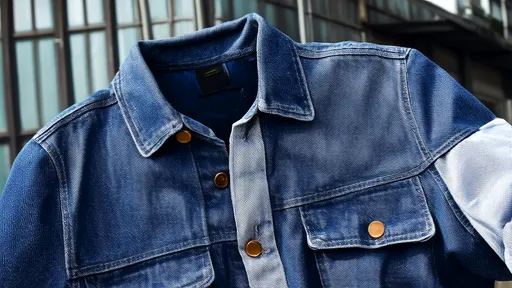
In the world of textile artistry, few names carry the weight and mystique of Denim Wash Art. This intricate craft transforms ordinary denim into a canvas of time, where every fade and crease tells a story. At the heart of this narrative lies the elusive pursuit of creating blues that whisper of years gone by—the kind of indigo that doesn’t just mimic age but seems to have lived it. The quest for this "time-worn" blue is both a science and an art, blending chemistry with creativity, tradition with innovation.
The foundation of achieving a time-infused blue begins with the fabric itself. Raw, unwashed denim, often referred to as "dry" or "selvedge" denim, serves as the ideal starting point. Unlike pre-washed varieties, raw denim is untouched by industrial processes, allowing it to develop unique characteristics over time. The indigo dye used in these fabrics is not fully penetrated; instead, it rests on the surface of the cotton fibers. This superficial application is key—it means that with wear, wash, and time, the dye will gradually fade, revealing the white core beneath and creating those coveted high-contrast fades.
But how does one accelerate this natural aging process without sacrificing authenticity? The answer lies in a series of meticulous washing techniques, each designed to replicate the effects of time. Stone washing, for instance, involves tumbling denim with pumice stones to abrade the surface, softening the fabric and lightening the indigo in a way that mimics years of wear. However, for a more nuanced, time-sensitive blue, artisans have moved beyond this method, embracing enzymes and ozone washes that offer greater control and subtlety.
Enzyme washing, using organic compounds like cellulase, breaks down the surface fibers of the denim, resulting in a softer hand and a more gradual fade. This method is prized for its ability to produce a vintage look without the harshness of traditional stone washing. Meanwhile, ozone washing employs gaseous ozone to oxidize the indigo dye, lightening it in a way that feels both uniform and naturally aged. This technique is particularly effective for achieving lighter, sun-bleached blues that evoke decades of exposure to the elements.
Yet, the true magic of creating time—the "sense of time" in blue—is not just in the washing but in the dyeing process itself. Natural indigo, derived from the Indigofera plant, has been used for centuries and is renowned for its depth and complexity. Unlike synthetic indigo, which can appear flat and uniform, natural indigo varies batch to batch, reacting differently to light, water, and wear. This unpredictability is what gives naturally dyed denim its character; each piece fades uniquely, developing a personal history that cannot be replicated.
Artisans often employ techniques like rope dyeing, where the yarn is dipped multiple times in indigo vats, allowing for a rich, layered color that fades in shades rather than all at once. This method, though labor-intensive, creates a multidimensional blue that seems to hold light and shadow within its fibers. When combined with subsequent washing processes, the result is a blue that feels earned, as if it has been lived in and loved over many seasons.
Beyond the technical processes, there is an almost philosophical approach to instilling denim with a sense of time. It’s about embracing imperfection—the slight irregularities, the unexpected fades, the subtle variations that machines often iron out. Hand-sanding, for example, is used to manually wear down areas like knees and pockets, creating fades that mirror the natural patterns of human movement. Similarly, laser technology is now being used to precision-fade denim, but the most revered pieces still bear the marks of human touch, because time, after all, is a human experience.
Another critical element is the role of water—the very medium of wash art. The mineral content, temperature, and pH of water can dramatically alter how indigo reacts. In regions like Japan, where denim craftsmanship is revered, artisans use local water sources known for their unique properties, believing that water imbues the fabric with a sense of place and time. This connection to environment adds another layer of narrative to the blue, tying it to the earth and the passage of seasons.
Finally, the finishing touches—whether it’s a gentle rinse to set the color or a specialized softening agent—are applied with an eye toward longevity. The goal is not just to make denim look old but to ensure it ages gracefully, continuing to evolve with the wearer. This dynamic relationship between garment and individual is what truly creates the sense of time; the blue becomes a record of journeys taken, of days spent in sun and rain, of moments that leave their mark.
In the end, the art of making time blue is a dance between control and surrender. It requires a deep understanding of materials and methods, but also a willingness to let the process breathe, to allow for the beautiful accidents that make each piece unique. It’s a reminder that time, much like indigo, is both a constant and a variable—always moving, always leaving its trace. And in that trace, we find a blue that feels less like a color and more like a memory.

By /Aug 21, 2025
By /Aug 21, 2025
By /Aug 21, 2025
By /Aug 21, 2025
By /Aug 21, 2025
By /Aug 21, 2025
By /Aug 21, 2025

By /Aug 21, 2025

By /Aug 21, 2025

By /Aug 21, 2025
By /Aug 21, 2025
By /Aug 21, 2025

By /Aug 21, 2025

By /Aug 21, 2025

By /Aug 21, 2025

By /Aug 21, 2025

By /Aug 21, 2025

By /Aug 21, 2025

By /Aug 21, 2025

By /Aug 21, 2025