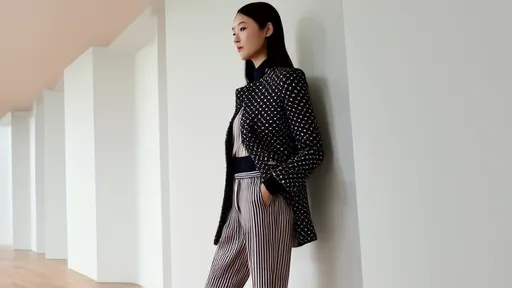
As the mercury drops and winter asserts its presence, the perennial sartorial challenge emerges: how to remain warm without surrendering to the bulk that often accompanies cold-weather dressing. The art of layering in winter is a delicate balance, a dance between practicality and elegance. It is not merely about piling on garments but about strategic composition, where each piece plays a role in both insulation and style. The goal is to achieve a silhouette that is both functional and flattering, defying the season's tendency toward shapelessness. This nuanced approach to winter wear transforms the necessity of warmth into an opportunity for sartorial expression, proving that one need not choose between comfort and chic.
At the heart of non-bulky winter layering lies the principle of material intelligence. The fabrics you choose are the foundation upon which your entire ensemble is built. Modern technical materials, such as merino wool, cashmere, and high-quality synthetic blends, offer exceptional thermal properties without the weight of traditional winter cloth. A base layer crafted from thin merino wool, for instance, wicks moisture and traps body heat with remarkable efficiency, performing the job of a much thicker garment. Similarly, a mid-layer of lightweight cashmere or a sophisticated fleece provides insulation that feels like a whisper against the skin but performs like a shout against the cold. The outer shell, too, must be selected with care; a well-designed trench coat or a streamlined parka with advanced insulating technology can serve as a formidable barrier against wind and precipitation without adding unnecessary volume. By prioritizing high-performance, lightweight textiles, you build a micro-climate around your body that is warm, breathable, and, most importantly, slim.
Beyond the science of fabric, the architecture of fit is paramount. Each layer must be considered not in isolation but as part of a cohesive whole. The base layer should be snug, almost like a second skin, to effectively manage moisture and heat transfer. A loose base layer creates air gaps that can lead to chills and disrupt the thermal regulation of the entire system. The mid-layer, whether a fine-knit sweater or a tailored vest, should follow the lines of the body without being restrictive. It is this layer that often provides the core insulation, so its fit is critical to avoiding a boxy appearance. Finally, the outer layer must have enough room to accommodate the layers beneath without looking overstuffed. This is often where mistakes are made; a coat that is too tight will cause bunching and discomfort, while one that is too large will swallow your frame. The ideal outer garment is cut with layering in mind, offering a clean, sharp silhouette that elegantly conceals the complexity within. Mastering this hierarchy of fit—from skin-tight to structured—ensures that each element complements the next, creating a streamlined profile that belies the warmth it provides.
The final, and perhaps most expressive, element is the strategic deployment of layers. This is where personal style and practicality converge. Rather than uniformly covering the entire body, consider the selective use of layers to add warmth where it is most needed while maintaining visual interest and a sense of lightness. A sleeveless quilted gilet under a coat, for example, provides crucial core warmth without adding bulk to the arms. Similarly, the use of long scarves or snoods protects the neck and chest—key areas for heat loss—and can be easily removed or adjusted as you move between temperatures. Even the choice of footwear and accessories plays a role; insulated boots with a slim profile and thermal socks can keep extremities warm without the need for heavy, leg-widening trousers. This tactical approach allows you to create zones of warmth, focusing insulation on the torso and vitals while keeping the extremities agile and the overall look refined. It is a method that acknowledges that not all parts of the body require equal defense against the cold, permitting a more dynamic and intelligent composition.
Ultimately, dressing for winter without succumbing to bulk is an exercise in mindful curation. It demands an understanding of how materials, fit, and strategic placement work in concert to create a whole that is greater than the sum of its parts. It is a rejection of the notion that winter style must be sacrificed at the altar of functionality. By embracing these guiding principles, you can navigate the coldest months with confidence, wrapped in an elegance that is as deliberate as it is warm. Your wardrobe becomes a testament to the idea that true style is not dictated by the season but is a constant, adaptable expression of self, regardless of the weather.

By /Aug 21, 2025

By /Aug 21, 2025

By /Aug 21, 2025

By /Aug 21, 2025

By /Aug 21, 2025

By /Aug 21, 2025

By /Aug 21, 2025

By /Aug 21, 2025
By /Aug 21, 2025

By /Aug 21, 2025

By /Aug 21, 2025

By /Aug 21, 2025

By /Aug 21, 2025

By /Aug 21, 2025

By /Aug 21, 2025

By /Aug 21, 2025

By /Aug 21, 2025

By /Aug 21, 2025

By /Aug 21, 2025

By /Aug 21, 2025